Washington Mom Buys a $65K House in Osaka
Oct 18, 2026What makes this Japanese house the right one?
When people talk about buying a house in Japan, we tend to talk about the house first
How old is it? How much does it cost? Does it have tatami? How much work does it need?
But if you're only going to be in Japan every few months, I think there's another question that matters just as much:
Does the house fit the life you're actually going to live there?
That was one of the things that struck me about Bree's house in Osaka.
Bree lives in Washington State. She doesn't have a car in Japan. She expects to come back every couple of months for a few weeks at a time, usually with family. She wanted Japanese character, but she didn't want to spend her time in Japan managing a major renovation.
Those requirements aren't particularly glamorous.
They are also exactly what made this house work.
The house was just one part of the decision
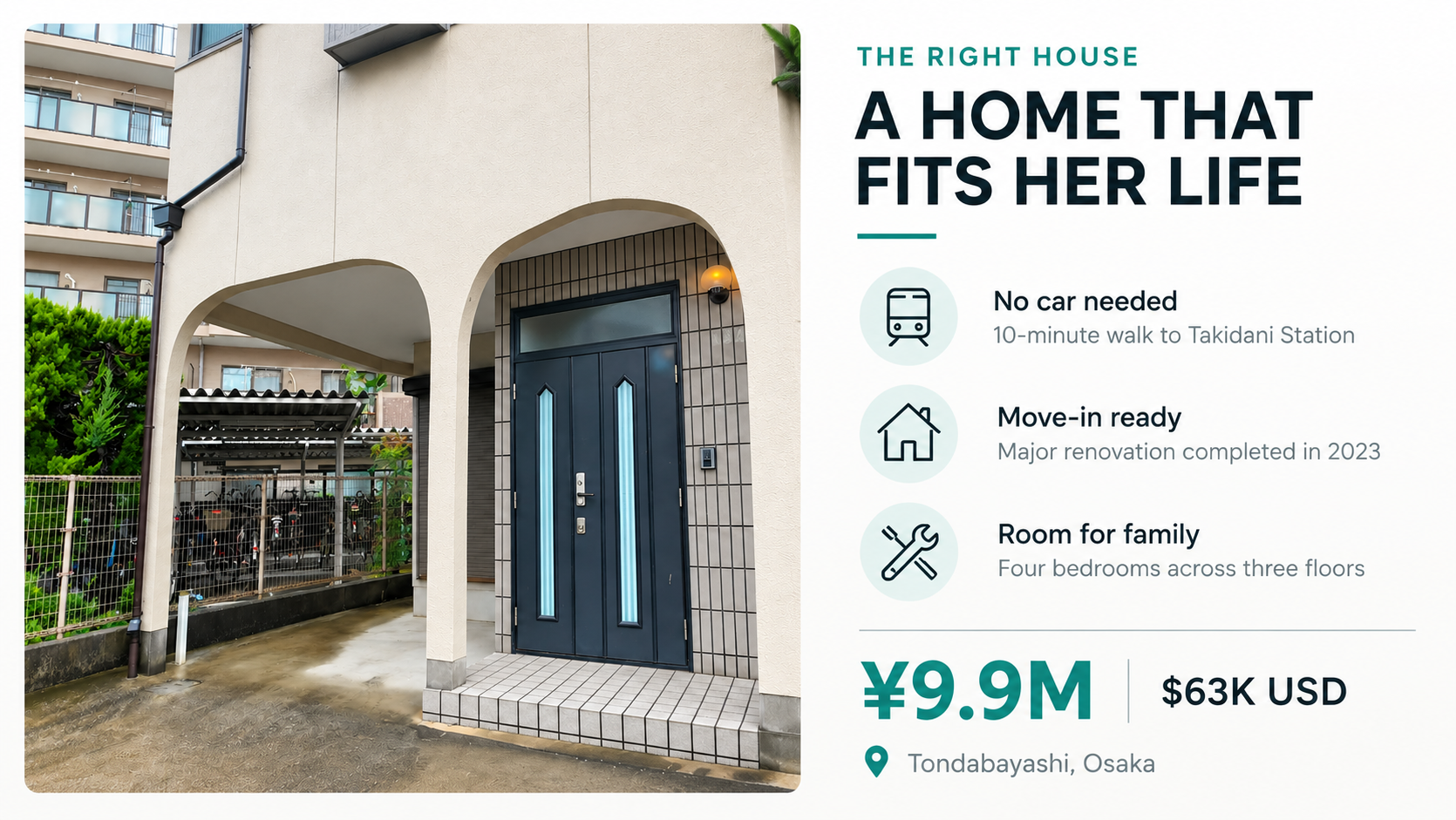
Bree's home isn't in the middle of Osaka City. It's in Tondabayashi, in the southern part of Osaka Prefecture.
At first, that might sound like a compromise if your mental picture of Osaka is Namba, Umeda, and the center of the city.
But Bree doesn't have a car.
Takidani Station is about a ten-minute walk from the house. From there, Namba is roughly 30 minutes, Umeda around 40 minutes, and Kansai International Airport about an hour.
There are also everyday things nearby, including a convenience store and local shopping.
For Bree, that combination is much more useful than simply being able to say she lives in central Osaka.
Convenience depends on your life.
The same location can be inconvenient for one person and very practical for another.
That's something I think is easy to lose when you're looking at properties from another country. A map can tell you where a house is. It can't tell you whether that location makes sense for the way you're going to use it.
She also knew what she didn't want
There is a romantic version of buying an older Japanese house where the fun is in taking on the renovation.
Bree wasn't looking for that.
The house had already been extensively renovated in 2023, including the kitchen and wet areas. It still has the things that give it Japanese character, including tatami and traditional sliding doors, but she doesn't have to begin ownership with a huge project.
That was important because her goal isn't to spend her trips working on the house.
She wants to use it.
The same thing came through when Christian showed me around. The house has four bedrooms across three floors, but they haven't even completely decided who will use which room yet.
And I actually liked that.
It made the house feel less like a finished property listing and more like a home the family was beginning to figure out.
Where will everyone sleep? Which room makes sense for Bree? What happens when the rest of the family comes?
Those are very ordinary questions.
They're also the questions that tell you whether a second home is going to work.
Start with the life you want, then find the house that fits
Bree eventually paid ¥9.9 million / $63,000 for the property.
But I don't think the most interesting part of the story is the number.
The interesting part is how many of her decisions came back to the same basic question:
What does this house need to do for me?
She needs to be able to reach it without a car.
She needs to be able to get back and forth from the airport.
She needs enough space for her family.
She wants Japanese character.
She doesn't want a major renovation.
She wants somewhere she can return to every few months and actually enjoy.
Once you know those things, the property search becomes much more specific.
You aren't simply looking for "a house in Osaka."
You're looking for a house that can support a particular life.

I think that's a useful exercise for anyone considering a second home in Japan. Before getting too attached to a property, try describing the life you want the property to make possible.
How often will you actually be there? How will you get there? Who will come with you? What do you want to spend your time doing once you're there?
Then see what kind of house answers those questions.
Bree's purchase from Washington was still scary. She says that herself. At one point, buying a home in Japan from overseas seemed "impossible" to her.
But she knew what she was looking for, and when she found a house that matched those requirements, the decision started to make sense.
By the end of the interview, she said something very simple:
"We own a home in Osaka."
That's really what the whole thing was about.
Not finding the most impressive house.
Finding the house that worked for her.
If you'd like to see the property for yourself, you can watch Bree's full story and house tour here: