
Fixing the House My Tenant Destroyed in Japan
Sep 03, 2026An old house has its own renovation plan
You can have a pretty good idea of what you want to do with an old house before the renovation starts.
The problem is that the house hasn't necessarily agreed to your plan yet.
That's one thing that struck me while working on the second update from the house I'm turning into a YouTube studio.
Once you start opening up ceilings, floors, and walls, the building starts giving you new information. Sometimes it's a problem. Sometimes it's a limitation. And occasionally, you find something you actually like.
The house gets a vote.
Demolition is also investigation
When I got the property back from the tenant, the obvious problem was the damage. The original estimate to restore it to rentable condition was ¥747,230, or about $4,600.
But that wasn't really the project anymore. I decided that if I was going to put money into the house, I'd rather turn it into something I could actually use.
So we started stripping the place down.
And that's when the second layer of the story appeared.
The smell, which had been one of the worst parts of the original problem, has mostly gone away because so much of the old material has been removed.
But underneath those finishes, we found things that had nothing to do with the tenant. Some sections of the floor had dirt where you'd expect something else. The first-floor ceiling wasn't as straightforward as it looked. There's a structural beam that can't simply be removed. There are also signs of past termite activity.
None of this means the whole house is falling apart.
It means we're learning more about the house now that we can actually see it.
That's a very different thing.
You have to be willing to change the plan
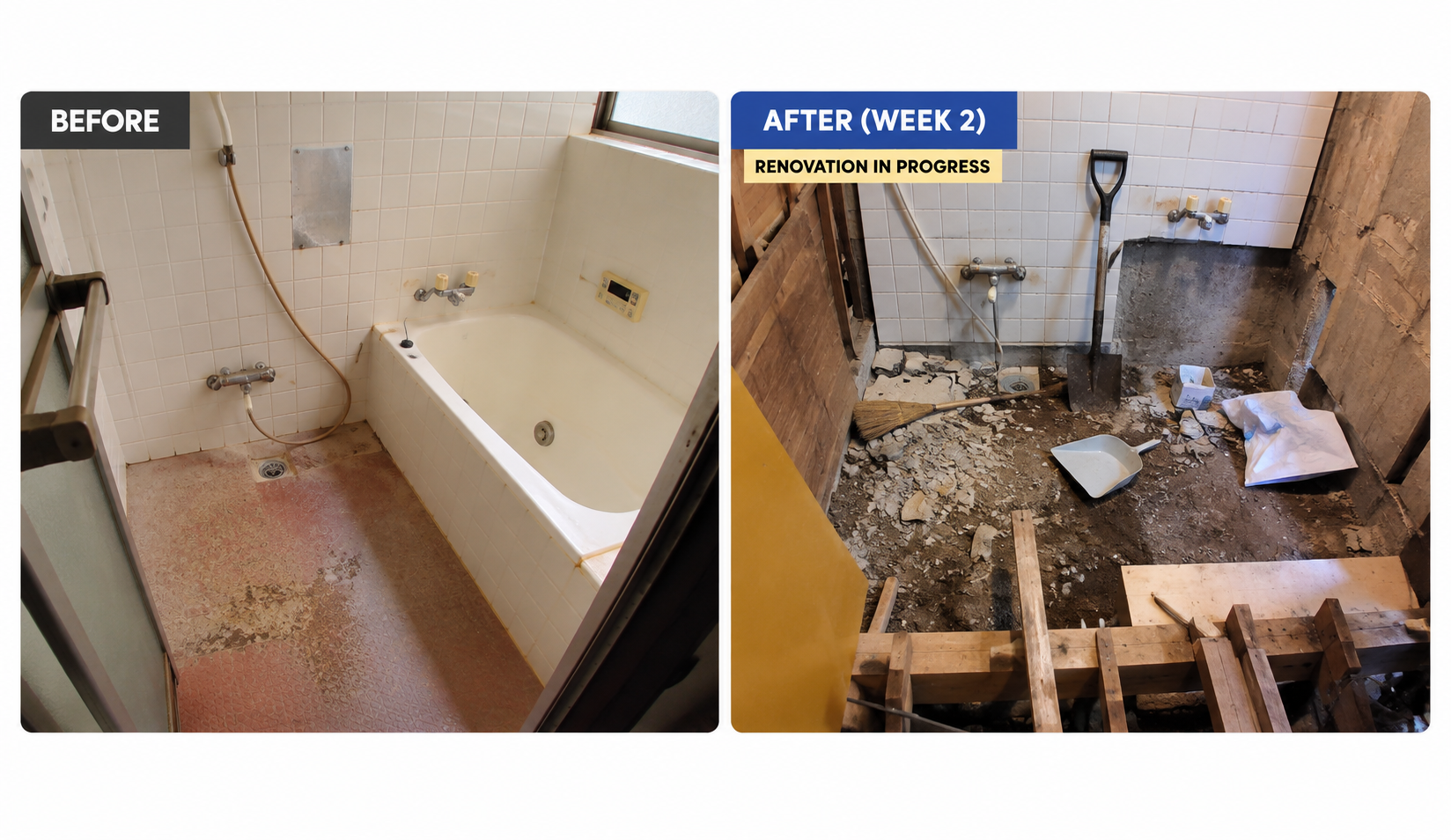
One of the first-floor ceiling areas is a good example.
I liked the idea of leaving more of the structure exposed. But once we understood the condition of the existing framework, along with the wiring and how the room needed to work, closing that section made more sense.
The shower created another small negotiation. The new unit overlaps the existing window by roughly 15 cm.
We could remove the window and close it up.
I didn't want to.
Being able to ventilate the room matters to me, so we're keeping it and working around the conflict.
Then there's the beam.
You can look at an old Japanese room and think, I'd love to open this whole thing up.
Sometimes you can't.
That beam is doing a job.
And then, after all of those compromises, you look upstairs and discover that the exposed ceiling is actually one of your favorite parts of the house.
That's the part I find interesting about renovating an older property.
You aren't just taking an existing house and imposing a design on it. You're figuring out what you've got, deciding what needs to change, and noticing what is worth keeping.
This is something I'd think about before buying
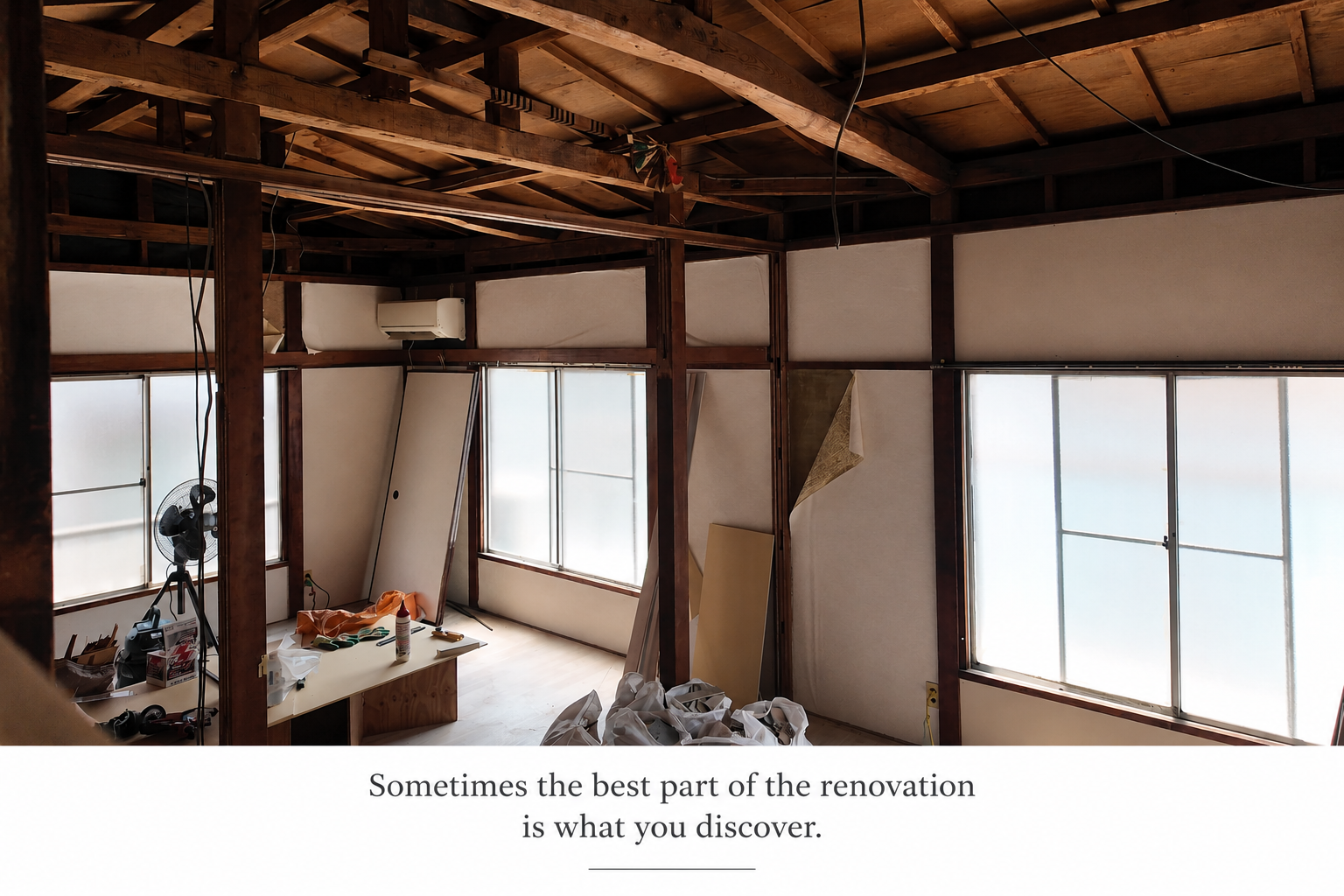
If you're looking at an older Japanese house, I wouldn't approach the renovation with a finished picture in your head.
Have a use in mind. Have a budget. Know what matters most to you.
But leave some room for the building to change your mind.
A floor plan can tell you where the rooms are. An inspection can tell you a lot about the condition. But there are still things that become clearer when work actually begins.
That doesn't mean you should blindly buy a cheap old house and hope for the best.
It means you should leave some flexibility in your plan for the house itself to become part of the decision-making.
And that's especially useful when you're renovating for a specific purpose. A house you're turning into a studio has very different priorities from one you're going to rent, use as a holiday home, or live in full-time.
In our case, that means we're now thinking about where the filming positions will be, where the outlets need to go, how the upstairs should be lit, where the LAN connection should run, and where the air conditioning will need power.
The house has given us some constraints.
Now we're figuring out what we can do with them.
If you want to see what that looks like in practice, we filmed the renovation as it happened, including the things we discovered once the house started coming apart.