
I Found Japan's Cape Cod Just 1 Hour From Tokyo
Oct 28, 2026The cheapest house isn't always the best value
When you're looking for a house in Japan, it's tempting to start with the cheapest listings
I understand that. The prices can be surprising, and it's natural to wonder what you can get for your money.
But after looking at four very different properties in Miura, Kanagawa, I came away thinking that the asking price is often the least interesting part of the comparison.
We looked at houses listed at ¥3.5 million / $22,000, ¥6.8 million / $43,000, and ¥12 million / $76,000, plus a much larger mixed-use building listed at ¥108 million / $684,000. They were all in the same general coastal area, but they offered very different things.
So how do you compare them?
A bigger house isn't automatically a better house
The ¥12 million property had plenty going for it. It was a spacious older home with a garage, a garden, and several Japanese-style rooms. There was even a small glimpse of the sea.
It also had older finishes and areas a new owner might want to work on.
The ¥6.8 million house was much smaller, with a listed building area of about 57 square meters compared with 121 square meters for the first property, including its garage.
Before visiting, I expected the smaller house to need more work than it actually appeared to. Once inside, I was pleasantly surprised. The interior had received some recent updates, and the balcony offered a better partial sea view than the first house.
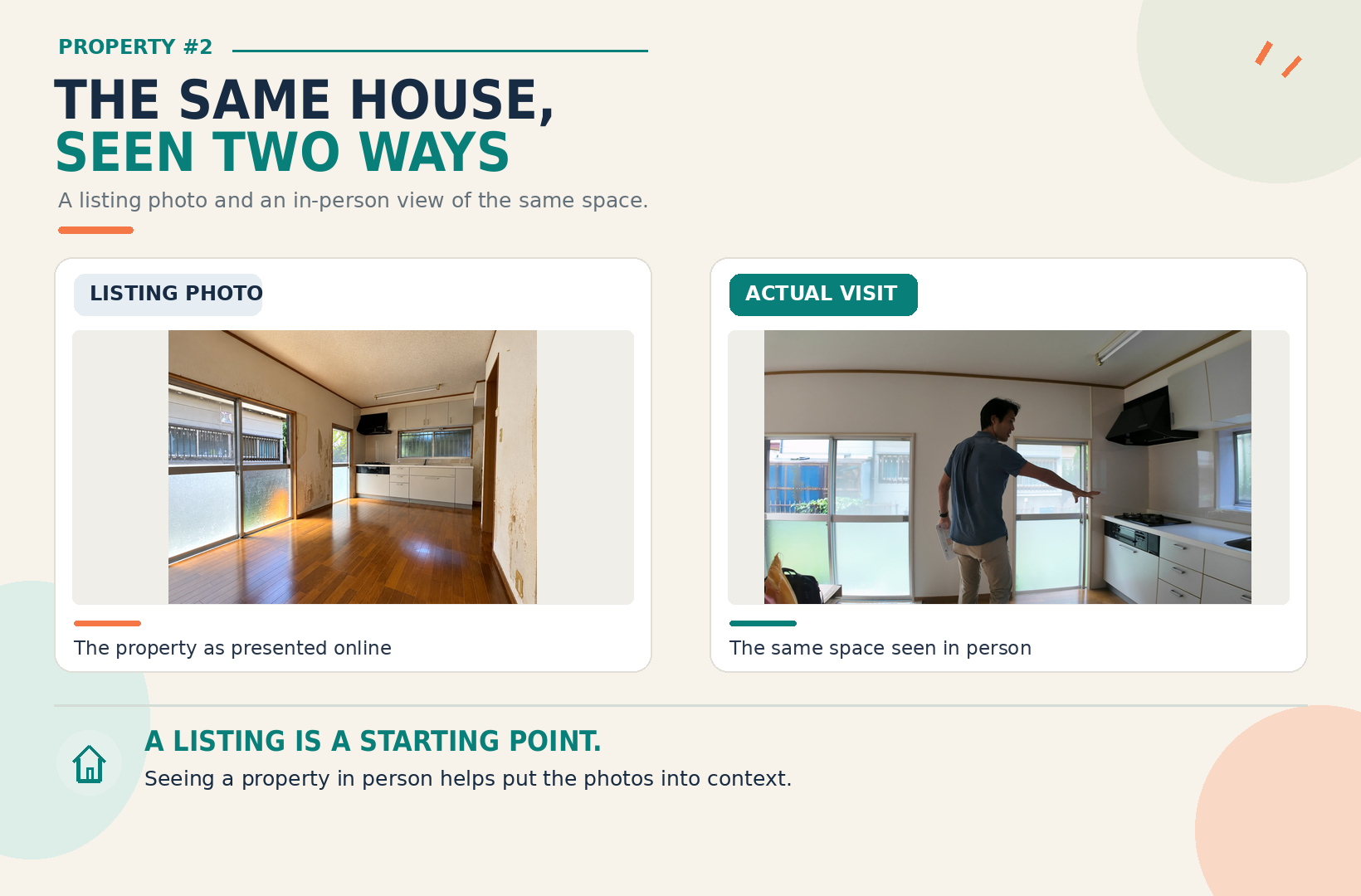
I liked what I saw.
Does that make it a better value? I can't say that from the visit alone. The houses have different amounts of space, different conditions, and different things to offer. But it does show why floor area and asking price don't tell you the whole story.
A smaller house might suit you better if you prefer its layout and current condition. Someone else might happily take on the larger property for its extra space.
You need to know what you're comparing before deciding which one appeals to you.
The ¥3.5 million house had something I really liked
The third property was the cheapest of the four, listed at ¥3.5 million. It was also the oldest, built in 1956.
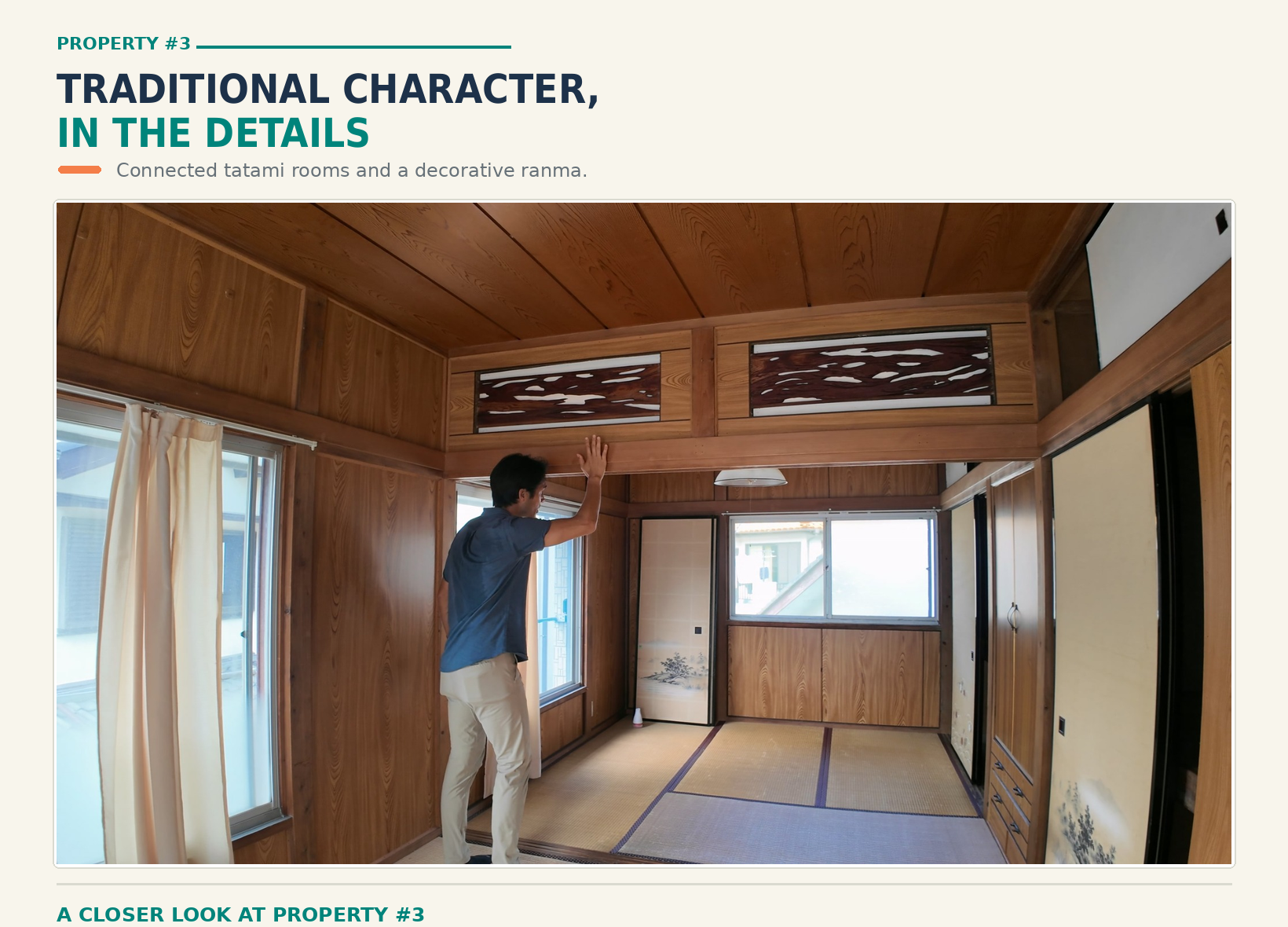
I liked its traditional character. The connected tatami rooms and decorative ranma (transoms above interior partitions) reminded me of an older Japanese home with a lot of history. I'd be inclined to preserve that feeling rather than strip it all out.
But the listing disclosed several things that a buyer would need to understand.
The toilet uses a pump-out system, with no sewer connection or septic tank. The listing also states that the building covers more of the plot than permitted, that the seller isn't identifying the boundaries, and that there is no on-site parking.
Those details don't tell us exactly what work the house needs or what that work would cost. They do tell us that the asking price leaves some substantial questions unanswered.
Liking a house and understanding what you're taking on are two different things.
I'd want to understand those conditions before deciding what I'd change, what I'd preserve, and whether the house suited my plans. I wouldn't put a total project budget on it based on a walkthrough.
And I wouldn't dismiss it just because those questions exist. The traditional rooms might be exactly what attracts someone to the property. The point is to understand both the appeal and the practical situation before making a decision.
What are you actually looking for?
Miura makes this particularly interesting because the coast is part of the appeal, but even the views differ from house to house.
One property offers a modest glimpse of the sea. Another has a better partial view. The third's outlook is restricted by neighboring buildings. The fourth faces a marina, but it's a completely different proposition: a much larger building with a former pharmacy and residential space.
If you want a weekend place near the water, your priorities might be quite different from those of someone who wants traditional rooms, a garden, or enough space to run a business.
You don't need to have every detail figured out before searching. But it's worth asking yourself what drew you to a property in the first place.
Is it the location? The space? The character of the house? The view? Or the chance to make an older home your own?
Once you know what you're looking for, you can start deciding which compromises are acceptable. A house that lacks one feature you wanted might offer something else you value more. Another might be cheap precisely because it comes with questions you aren't prepared to deal with.
Neither outcome is obvious from the asking price.
I still think inexpensive houses in Japan are worth exploring. A low price is a perfectly good reason to take a closer look. It just shouldn't make the decision for you.
If you're browsing properties, try comparing a few that appeal to you for different reasons instead of sorting everything from cheapest to most expensive.
Find Your Dream Property in Japan with Map Search
And if you'd like to see the Miura houses for yourself, you can watch our full property tour here: