
15 Minutes From Kyoto Station. This House Price Makes No Sense.
Aug 19, 2026The Hardest Part of Buying an Akiya Isn't Finding One
At first glance, there's nothing about this Kyoto house that looks like an akiya.
It's bright, open, modern, and full of carefully considered details. Upstairs, a huge glass wall brings in natural light and opens up the view. The original beams are still visible. The whole space feels much bigger than you would expect from a house of roughly 70 square meters.
But what interests me isn't really the transformation.
It's everything that had to happen to make it possible.
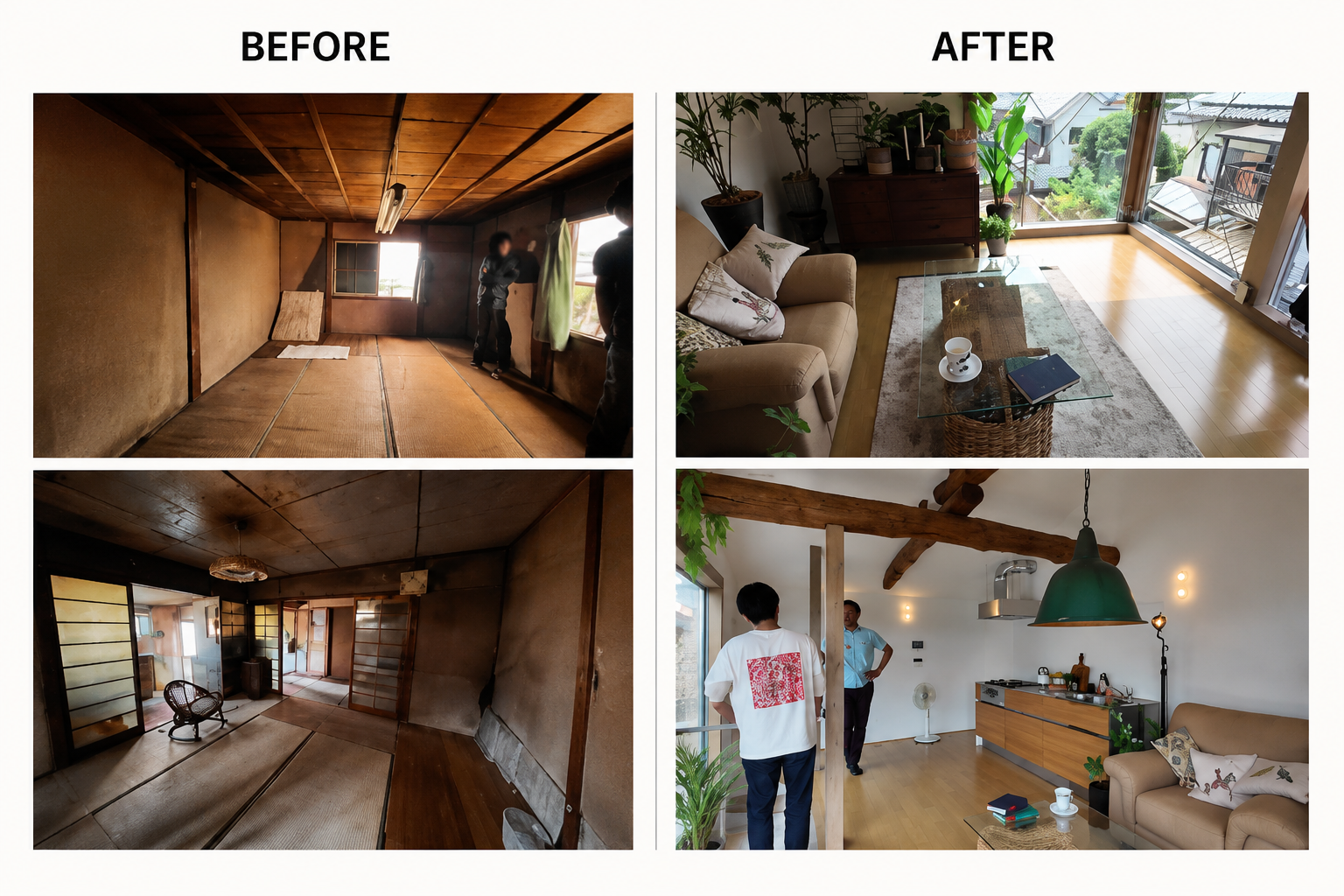
The house had been an ordinary older property. It sat vacant for years. Turning it into this involved much more than repainting a few rooms and putting in a nice kitchen.
Walls were removed. Parts of the roof were replaced. The exterior was renovated. Large glass panels were installed. Structural changes were made. Some of the original timber was carefully kept.
And the renovation cost approximately ¥25 million.
Let’s think about that number for a minute.
Not because ¥25 million is what renovating an akiya always costs. It isn't.
But it does show how easy it is to look at an old house through the wrong end of the telescope.
You find a property you like. The asking price looks surprisingly low. You start imagining what you could do with it.
Then you have to ask: what happens after you buy it?
The listing is only the beginning
I think people sometimes focus too much on finding the right akiya and not enough on what happens once they find one.
The property search is exciting. You can browse listings from anywhere in the world. You can compare locations, prices, floor plans and photographs.
Renovation is where things get more complicated.
Someone has to understand the building. Someone has to work out what can realistically be changed. Someone has to coordinate the construction. Someone has to deal with the local side of the project.
And if you live overseas, someone still has to be there when the work is finished.
The ¥25 million figure from this Kyoto project is renovation cost only. It doesn't tell us the property's acquisition cost or the complete cost of owning and completing the project.
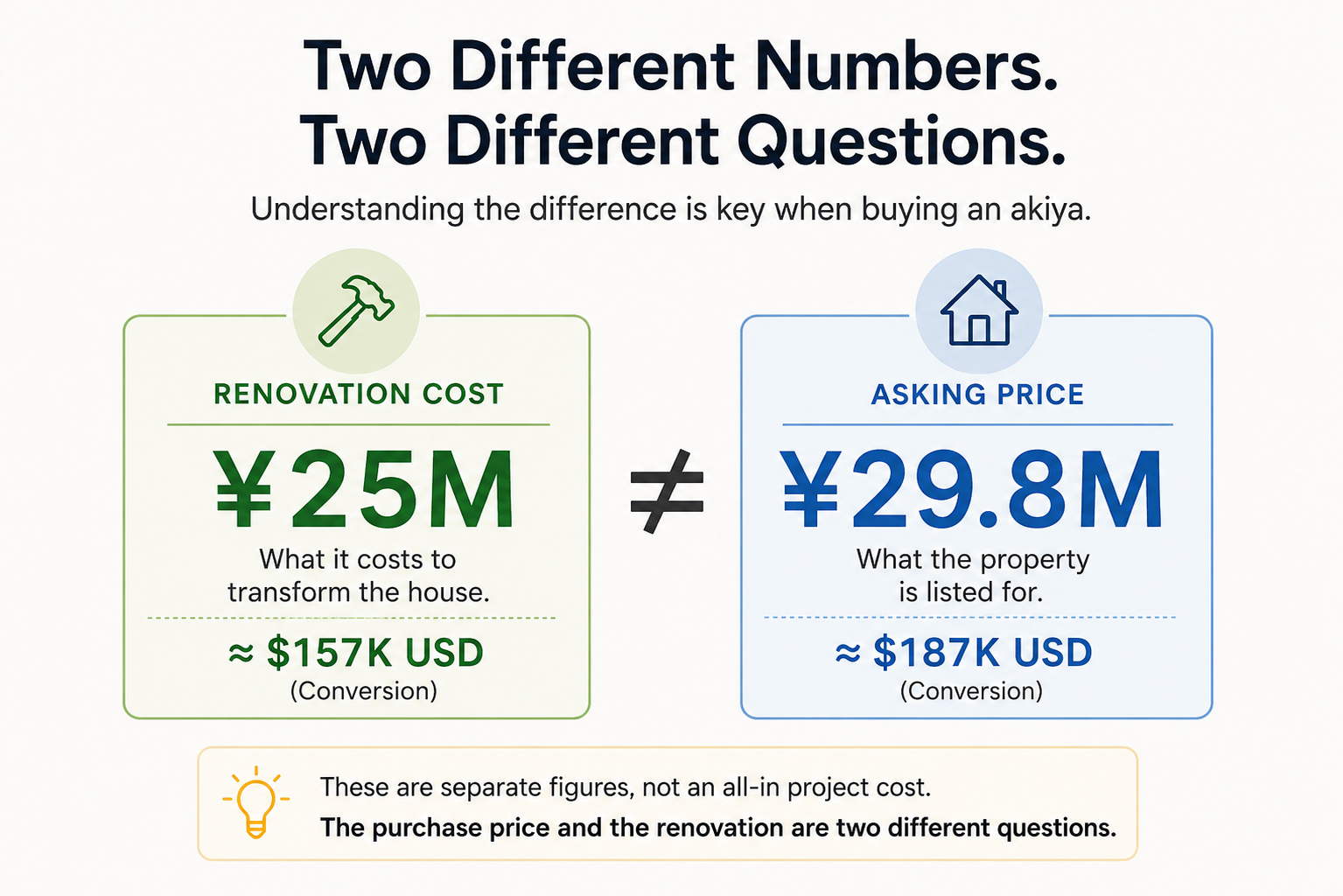
Taken in isolation, that ¥25 million is actually incredibly useful.
It reminds us that the purchase price and the renovation are two different questions.
A house can be inexpensive to buy and still require a serious renovation budget.
It can also be worth doing. Those are separate questions too.
Then there's the part nobody photographs
The finished house looks great in photographs.
You don't photograph the person arranging maintenance six months later.
You don't photograph the local coordination that happens when you're back overseas.
You don't see the tax representative, the contractor, the property manager, or the person who has to deal with a problem when you're sitting on the other side of the world.
That's why I found Taka-san's role in this project interesting.
His involvement isn't limited to finding or renovating a property. His company can also help with purchase, renovation, management and maintenance, along with some of the practical support an overseas owner may need.
I'm not saying every buyer needs a one-stop company. You can put your own team together.
But you should know what that team is before you buy the house.
Before buying an old property, I would want a clear answer to one question: who is going to look after this place when I'm not in Japan?
That's an easy question to forget when you're standing in a beautiful renovated kitchen.
The house is really a project
This is probably the biggest thing I took away from this property. It’s something I keep coming back to, because it’s something I’ve seen so many times in years of helping people find the home that fits their vision of life in Japan.
An old house isn't automatically an opportunity because it's old. And it isn't automatically an opportunity because it's cheap.
The building has to make sense.
So does the location.
So does the renovation.
So does what you want to use the property for.
And, particularly for an overseas owner, so does the plan for managing it afterwards.
That's what makes this Kyoto house interesting to me. The finished design is the part that grabs your attention, but the design only works because a whole series of other pieces came together behind it.
The house is where the project starts. It isn't the whole project.
If you're looking at akiya from overseas, I'd keep that in mind the next time you find a property that looks like a bargain.
Don't just ask, “Can I afford this house?”
Ask what you're going to need to make it work.
If you'd like to see the Kyoto house that prompted this thought, you can watch the full episode here [15 Minutes From Kyoto Station. This House Price Makes No Sense.]