
Hawaii Couple Buys a $93K House Near Tokyo
Oct 11, 2026How much renovation can you actually manage from abroad?
Let’s start with two Japanese houses
One costs ¥5 million / $31,000. The other costs ¥15 million / $94,000.
The first one needs a lot of work. The second one has already had most of the big renovation done.
It is pretty easy to start calculating the renovation budget and decide the ¥5 million house is the better deal.
But if you live overseas, there is another cost that doesn't show up on the spreadsheet.
Who is going to manage the renovation?
I was thinking about this while working on our latest video with Derek and Kris Higa, who bought a house in Narita while living in Hawaii.
They looked at other properties during their search. One looked promising in the listing photos, but when they saw it by video, they realized it needed more work than they wanted to take on from Hawaii.
That doesn't mean the other house was bad.
It just wasn't the right project for them.
And I think that's an important consideration for anyone buying a Japanese house from another country.
Renovation takes more than money
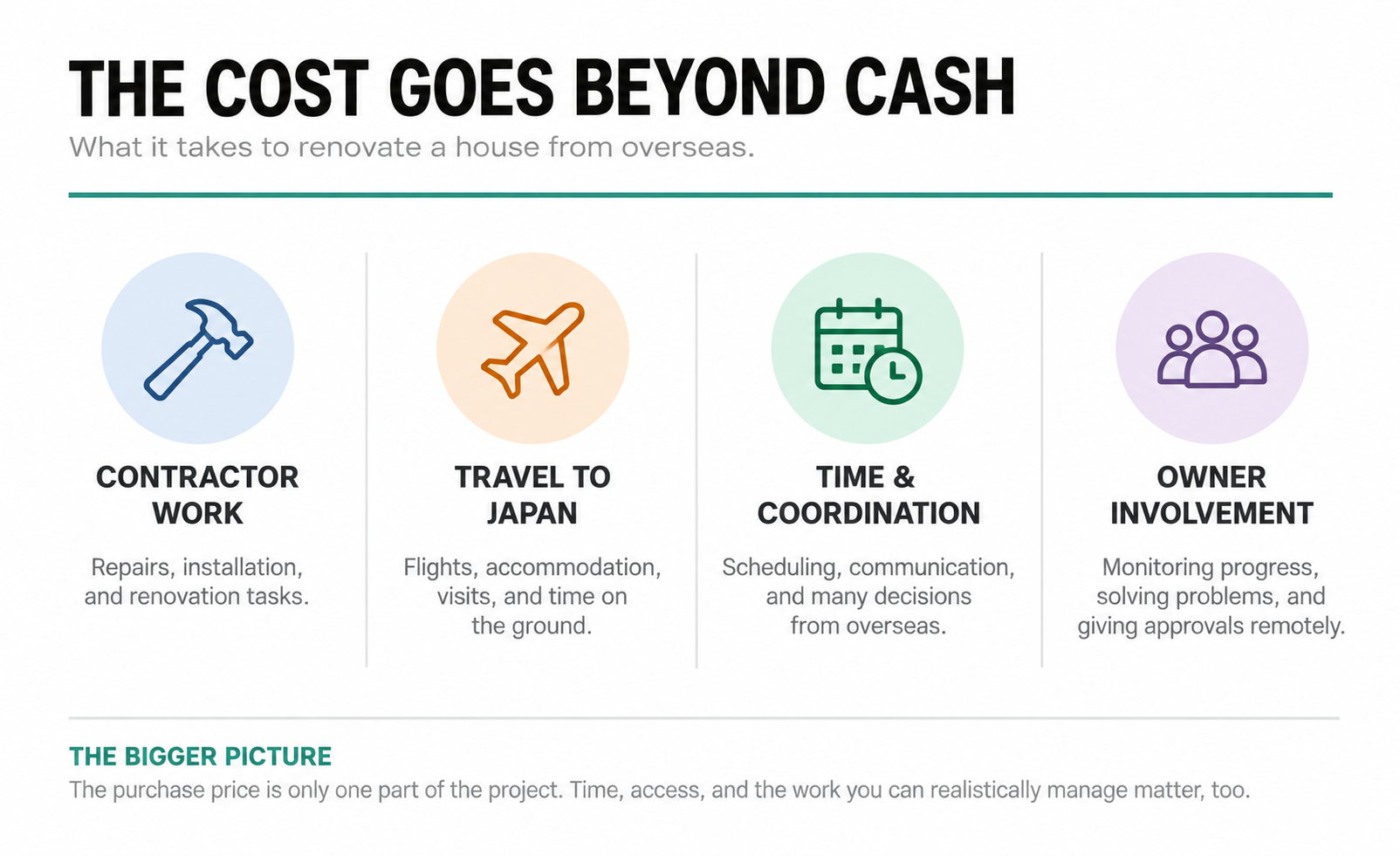
A major renovation means contractors, decisions, deliveries, questions, changes, inspections, unexpected problems and a lot of back-and-forth.
If you're living five minutes away, you can go and look at something yourself.
If you're living in Hawaii, California, Australia or Europe, you may be doing all of that by phone, email and video. Sometimes you'll need someone local to be there when you can't.
And there is another thing that is harder to put a number on.
Your time in Japan.
Derek and Kris weren't looking for a restoration project. They wanted somewhere their family could actually stay when they came to Japan.
That changes the calculation.
If you only get a few weeks in Japan each year, do you really want every trip to begin with another list of things that need fixing?
Some people will say yes. And that's completely reasonable. If you enjoy renovation, have experience managing contractors, or simply want to take on a big project, an inexpensive house that needs work might be exactly what you're looking for.
But you should know which person you are before you buy the house.
Derek and Kris didn't buy a house with nothing left to do
Their Narita house wasn't magically finished when they got the keys.
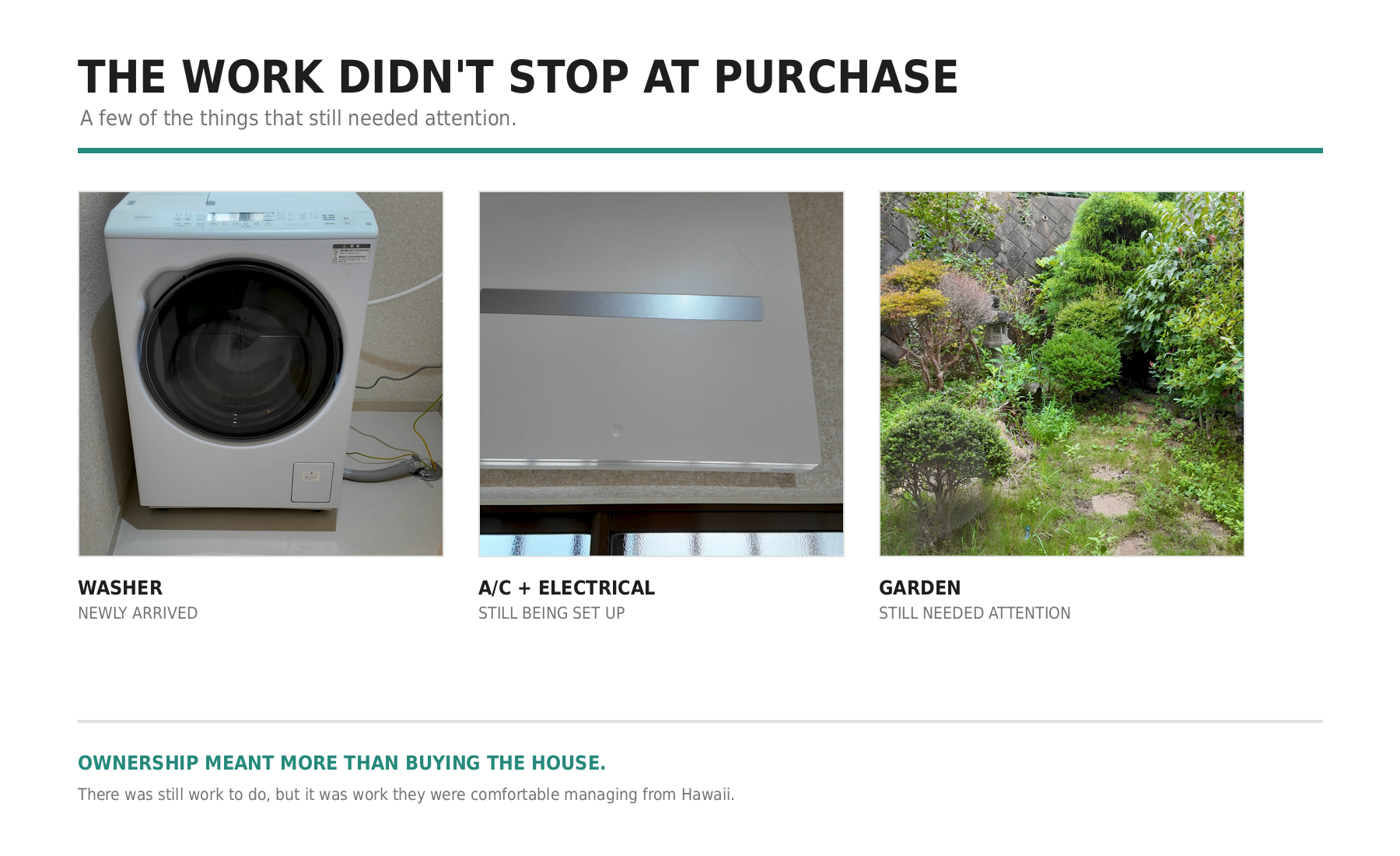
A washer had just arrived. A/C and electrical work had been added. Furniture was still being arranged. The garden still needed attention.
So they didn't eliminate the work.
They chose how much unfinished work they were comfortable owning.
That's a much more useful way to think about it.
There is a huge difference between buying a house that needs some setup before your next family visit and buying a house that needs a major restoration before it can really be used.
The asking price doesn't tell you which one you're looking at.
Ask yourself who owns the project
When you're comparing an inexpensive akiya with a more expensive, more usable house, I would add one question to the usual list of price, location and condition:
How much project can I realistically manage?
Not theoretically.
Realistically.
Where do you live? How often can you get to Japan? Who will be there when you can't? How comfortable are you making renovation decisions remotely? How much of your limited time in Japan are you willing to spend dealing with the house?
Those answers might lead you toward the cheaper property.
They might lead you toward the more expensive one.
There isn't a universal right answer.
For Derek and Kris, ¥14.8 million / $93,000 bought them more than the building itself. It bought them a house they could start using as a family base without first taking on a major restoration project from 4,000+ miles away.
That was what made the property fit their lives.
Before you fall in love with the purchase price, make sure you know what you're actually buying.
We filmed the whole visit to Derek and Kris's house in Narita, including the property, their search from Hawaii, and why this particular house made sense for them.